Showing posts with label commentary. Show all posts

March 5, 2022

It Takes a Village

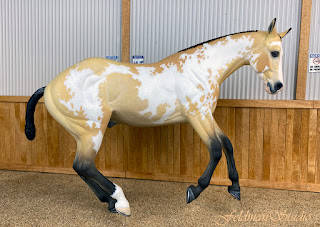
Rebel Just for Kicks

As I've been posting the creation of Rebel Just for Kicks, I noticed that I was often crediting someone for a tip or bit of inspiration. While it's important to give credit where credit is due, it wasn't lost on me that my artistic journey has been supported and influenced by many, many people along the way. I would not be the artist I am today, or the artist I hope to become tomorrow, without so many people sharing, inspiring, and lifting me (and so many others). There are many, many people on my journey that I am grateful for, but at the risk of leaving people out, I'd like to highlight those that came to mind as I worked on this piece.

Back in high school, my art teacher and fellow equine lover, Carolyn Freese, taught me to really see things. I will be forever grateful that she fostered my love of art. 

Sommer Prosser sculpted the Breyer model Harlee D Zip that is the foundation of this project. Such a lovely canvas requiring very little in the way of must-make corrections to get him show ready. Most of the customizing was done to make him more performance friendly, or to try to add a touch more realism where mass production made him less so. 

The person that introduced the use of soda glue was Sarah Rose. Many years ago she posted an article on fixing Khan's ear (one of her iconic resins), and it was a game-changer. I don't think I could customize without soda glue!
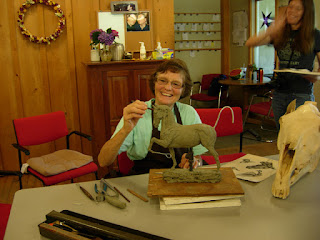
Kathleen Friedenberg

I have been blessed with the opportunity to attend a handful of sculpting workshops.  One was an AAEA sculpting clinic with Kathleen Friedenberg just before I moved away from PA (I delayed my move so I could attend!). I still use her approach to starting a sculpture, and I'm sure many other fine points I may not even realize. 

I also had a one-on-one sculpting session with Morgen Kilbourn to work on Panache (who will get done someday...) This session, along with helpful videos she posted, helped me to see better how the neck functions. I am not perfect at it, but I do feel I am getting better at sculpting necks, which came in handy since Rebel has an all-new neck for his performance-friendly headset. 
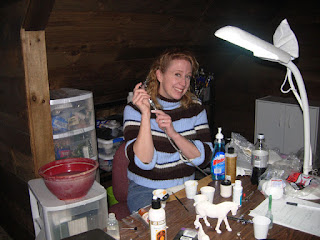
Tiffany Purdy

The idea for magnetized and interchangeable manes and tails was inspired by my friend Tiffany Purdy. She is also the one who introduced me to airbrushing (and threatened to take away my airbrush if I ever made round, unrealistic, airbrushed dapples, lol)! The work on her NaMoPaiMo horse and in-progress photos pushed me to try to do a little more shading and color layering than I normally attempt with the airbrush. I admit I am not comfortable using the airbrush for much more than putting on a basecoat. 

The idea to build up support under the interchangeable manes before sculpting them so that it is easier to take them on and off came from Kylee Park's Breyerfest class during the 2020 virtual BF. 

Jenn Danza is a pioneer in using pastels on models. I had only used them as sticks directly on paper, so the idea of grinding them down and sealing them on a model was revolutionary for me. The majority of my work has been made with pastels and acrylic paint over the years (but thanks to Heather Bullach's oil painting workshops, I am branching out!)

I would be remiss not to recognize Leslie Kathman for her sharing of color genetics, the application of it for artists, and a bazillion beautiful reference pictures. One of many tips I've taken from her came from one of her Breyerfest workshops. She demonstrated how the stifle is generally one of the darker areas and now I can't unsee it! Not to mention I am getting better at seeing and replicating realistic patterns.

The introduction of Liquitex High Flow Acrylics for white markings is all credit to Mel Miller. She is always experimenting with new products and techniques and sharing her wealth of knowledge with the model horse community. This year she and Kenzie Williamson introduced the use of a white paint pen. Genius! (You simply must try it!)

Sarah Minkiewicz needs no introduction, a longtime pioneer of model horse artistry and generous with her knowledge. Along with oodles of good things along the way, one tool I picked up from her recommendations is the Prospek caliper tools. I use these for measuring proportions during sculpting, and they handily made an impromptu stand for Rebel!

The impetus to record Rebel's progress here on the blog goes to the following bloggers, whose blog posts continue to be a wonderful connection to the hobby on any given day. And not only do they blog, but they take the time to post comments on my blog, which is always much appreciated. Thanks to (in alphabetical order) Sue Bensema, Jennifer Buxton, Anne Field, and Lynn Isenbarger! Seriously ladies, thank you for putting your blog posts out there day after day. Blogging is a lot of work!

Thanks to Mares in Black, Jackie Arns-Rossi and Heather Malone, for giving a shout-out to my Rebel in the Making blog posts. It is always a lovely surprise to get a mention. The MIB podcast has been a solid connection to the hobby, shares inspirational artwork of others, and is always a great listen when I'm working on horses "in the zone".

Last, but not least, I want to thank the NaMoPaiMo community (and especially the founder and champion of NaMoPaiMo, Jennifer Buxton) for the sharing of progress pictures, triumphs, fails, inspirations, tips, and general encouragement. Without this, I would have thrown in the towel at many points in the process.

Thank you!

December 17, 2021

Plagiarism or inspiration?


Many people have posted their feelings, thoughts, and advice on the recent Takeshi incident. I'm not looking to rehash all the details or create drama. Many others have shared very thoughtful posts. I can only share from my own experience.

I wouldn't say that I have created any iconic pieces in the hobby, but I did have a piece that I believe was blatantly copied. In my case, an individual reached out to inquire about buying my little Cheveyo resin custom and I declined. He's a personal piece that I adore. I customized him to standing with a braided mane, moved and braided his tail, and painted him bay with no markings. I later saw this same individual listing for sale a bay Cheveyo with the front leg lowered, braided mane, and a braided swishy tail. My best guess is she had a piece commissioned similar to my custom resin when she couldn't purchase mine. I doubt the artist that recreated this piece had any idea that my piece even existed, so I am not trying to place blame on the artist. I was shocked the first time I saw the duplicate. I felt emotions I'm not even sure how to describe. I have a little solace in the fact that I still like mine so much better. Still, it didn't (and still doesn't) feel nice. I feel like my creativity was violated, which is very personal.

Excessively Diverted
(his name is a nod to Jane Austen's writing)
customized Sarah Rose Cheveyo resin


There is also the issue of artists using other art pieces as inspiration, which is the case with Takeshi. More than a decade ago, I recreated several Hamilton paintings and another painting into models. At the time, I thought that the age of the paintings made it reasonable for me to go ahead and recreate a 3-dimensional version of those paintings. I now know better and would only venture to create something based off of another artist's work if it is in the public domain. 


Last year's Breyerfest Diorama Contest used this concept of using public domain art to inspire artists and the results were amazing, as Jennifer Buxton shared on her blog. I took the opportunity to recreate Stubb's Affrighted at a Lion. 

BreyerFest Diorama Entry 2021


There is another element where artistic integrity is in jeopardy, when a piece is altered without the original artist's permission. It is disheartening when I hear others, often but not always non-artists, say that once they have purchased a piece it is theirs to do with as they want. This is not okay. Sarah Minkiewicz did a fabulous episode on the Mares in Black podcast explaining why it is not okay, so I encourage you to go give it a listen. 

I think education is how we as a hobby move forward. Let's keep the conversation going. We can do better, we need to do better. Because when you know better, you do better. 


February 11, 2012

An Artist's Work is Never Done

 CastaƱateo
Brioso Sculpture by Sarah Rose
who may or may not be finished...
Collection of the Artist

The plight of an artist is finding satisfaction with one's own work. I have a dear friend that is always winning with her work, even though it's "not done yet". :) I, too, am guilty of never being finished with some of my work. I find myself wanting to rework or tweak many in my personal collection. Some of them I know are in progress. Others I may want to try something new. As my techniques have changed over the years, I realize that this is part of the journey of being an artist. Self discovery is an ongoing process. The above piece has already been through one revision since his original creation. I think he may find his way back to the painting table again after I complete this recent batch of dapple greys, having learned a thing or two.

As I look to wrap up the commissions that I previously posted about this coming week, this thought of finding satisfaction in a completed piece comes back to me. Will they come together as easily as I envision, or will I find the need to do a little more tweaking? Only time will tell.

January 19, 2011

Muse - Friend or Foe?


 I received an email some time ago from another artist and she commented on how distractions get her going in a million different directions. I think every artist struggles with creativity, invention, and getting stuck behind problems. The muse is a fickle friend it would seem. At times I can lose track of hours zoned in on a project. Other times, I patter around looking for inspiring reference material, surfing the internet, or otherwise wasting precious time that could be better spent creating. Of course, this refers to those rare gems of time I have carved out to work in the studio. So what have I done with the holiday, snow day and sick day that made up the last three days? I got out my power tools and cut wood to make props. Yup. In my defense, I did finish the prepping I had planned to have done for the last few commissions beforehand. But did I work on that exciting new drafter? Nope. These props I have had on the back burner since summer and I got tired of looking at the pile of wood downstairs. I think they're coming along, but it's taken me forever with lots of trial and error. I think I have it down now and I'm making up some extras to offer for sale ... some day ... when the muse strikes again...

March 27, 2009

Creativity isn't everything

Orchestrating productivity in the studio is more about project management and organization than creativity.

For example, I was repairing an Animal Artistry mini resin's legs today (that's the picture of him before the accident). After inserting wire into his leg and sculpting over the repair, I had a tiny glob of apoxie left over. So I smooshed it in place on another piece that is in progress. Of course, the loss of a small amount of apoxie will not bring my productivity to a screeching halt (I have plenty of other distractions for that to happen), but planning ahead so that I always have an in progress piece in need of filler keeps things humming along. By so doing, that little model will be ready for sculptural detailing next time I go at it with apoxie, as the fill work is now done.
Another productivity saver for me is working in batches. I rarely work on one model at a time, especially when it comes to prepping. I usually prep in batches of about a half dozen models. They all get their seams cleaned, then all get a bath in Comet, and so on. Why get the mess out for just one model at a time? This is true when working with pastels, too. Pastels make such a mess of my work table, that I usually try to work in batches of about three models at a time (more than that is more distracting than helpful for me personally). They aren't all the same color (I'm not mixing batches of wet paint that need to be used up), but they all go through the pastel phase together. Then I clean up my work area completely and they all go through the detailing stage together, whether one takes 5 hours or 50 hours to detail. In this case, I am working with wet paint for eyes and hooves and I'm less likely to waste paint on those small areas if I have more models to use it on. And when I'm done, hopefully I have another 3 models already prepped from the last prepping session to start on.
:D

February 17, 2009

Woes of Technology


I knew the hard drive was on the way out, I backed everything up (I thought) to our massive external hard drive, having been victim of "learning it the hard way" the last time our hard drive failed...
Our laptop isn't even two years old, but shutting it off in the midst of a Microsoft update proved disastrous for Ruby (the laptop). I ran the backup utility, which was set to backup EVERYTHING on the hard drive, just to be on the safe side. Then I performed a back up of Quicken into its own little folder. Then I tried to tackle Outlook. I installed some nifty backup tool provided my Microsoft and followed the instructions, putting it in its own little folder where it wouldn't get lost.
Well, the new hard drive is running nicely (thank goodness for warranties), and I downloaded all the drivers, the antivirus software, Office, Quicken and the printer (I still have oodles of software to download). Quicken is up and running with all the data intact, but much to my dismay all my Outlook data appears lost forever. The backup didn't backup the .pst personal file, it actually appears that it didn't back up anything. And my back up in case that didn't work was that I had done a back up for the whole darn C drive. Nope - it doesn't back up certain types of folders/files and that included the App folder under my user name that housed the personal file. I believe there are times we need to purge in our life, but I usually prefer it be on my terms. It's always refreshing to clean out the closet and the boxes stacked up and donate stuff to your favorite charity. And there is much to be said for simplifying our lives. I just wish I could still have all my contacts, past emails, and tasks at my finger tips. This happened to me once before and I survived. Lesson learned - again. Luckily, the most precious things (the thousands of photos of our family) and critical things (financial data) are intact.
So, after you finish reading this, please go back up your data!

February 8, 2009

The Artist's Eye

An interesting discussion cropped up on the RESS forum, started by Lesli Kathman, and I wanted to share a bit with you.

First of all, take a moment to take the Munsell Hue Test to assess how well you see color. The lower the score, the better you "see" color. Now, keep in mind that monitor variations may alter your score a little.

My husband thinks I see colors funny. It all started because I called his Honda Accord brown when he thought it was grey. In his defense, the factory color was called "Charcoal." Now, brown is a very broad term for color, but he would not accept that the car was more brown than grey. Grey is an interesting color becuase it can have brown tones that make it warmer. The point is, I felt vindicated when I got a near perfect score on the hue test. Ha ha!

But, it makes me wonder about how people see colors differently. As an artist seeing color is important, obviously. But what about the buyer of a piece? Does the interpretation of a piece change simply because somone sees colors differently than you? For example, choosing paint and looking at more than a dozen shades of "beige." While some people think they all look the same, others can distinguish more gold or more grey in each color chip. In our last house, the beige on the wall and the beige carpet didn't quite work together, in my opinion. Did the previous owners not see it (or maybe they just went with what was on sale)? When working on our next house, a fixer upper, I was thrilled to be able to make sure the carpet worked with the color palette I had chosen for the walls. I think the color harmony contributes to the peacefulness of the environment (when all the toys are put away, that is). Of course, everyone knows colors affect mood (which is why Pizza Hut is red, which is supposed to make you hungry), but does the harmony of hues also affect mood? And what does that mean, if some people can't distinguish hues while others can?

I think part of seeing color is developing an eye for it. I had a great art teacher in high school that taught us how to start looking for color. She really pushed us to see beyond the obvious to see what colors were making up the object (like green in skin tones). Being from Illinois, I became fascinated by the range of colors in the corn fields. There is an infinite number of shades of green, alot depending on how the light is filtering through it. Nature is so full of color. Look at the picture above. Leaves aren't just green, but a hundred different shades of green. And green happens to be my favorite color, maybe because nature is replete with so many variations of it. It has a soothing effect on me, which is why my kitchen, master bath and bedroom are all a different, lovely shade of green.

But, maybe not everyone can be trained to see color? Are there limitations that prevent some individuals from seeing hues as clearly as others? And likewise, are some people naturally able to distinguish colors more easily? There is a study showing that some women are tetrachromats and can see in four colors, having an extra cone on the X chromosome that allows them to see millions more colors than the average person. I wonder what percentage of these individuals find themselves drawn to artistic fields?

So our genetic makeup determines how we see color. We can be trained to "see" color to the extent that we actually can distinguish the hues. And even for those who are only trichromats, there are still millions of colors to enjoy.